Customer churn is the percentage of customers who stop doing business with you over a defined period. They cancel a subscription, don't renew a contract, or simply don't come back. It's the inverse of retention, and for most subscription and recurring-revenue businesses, it's the single most important number on the operating dashboard.
I've spent most of my career running CX inside companies where churn was a daily metric. At Mejuri during a period of hypergrowth, then at Canada Goose where the post-purchase relationship matters more than people assume for a luxury brand. The thing nobody tells you about churn is that most teams measure it wrong, fix the wrong category first, and confuse prediction with prevention. This guide is the version I wish someone had handed me at the start.
What Is Customer Churn?
Customer churn, also called customer attrition, is the rate at which existing customers stop engaging with a business in a given period. The "engagement" part matters. For a SaaS product, it usually means subscription cancellations. For DTC ecommerce, it's customers who don't reorder within an expected window. For financial services, it's account closures. The mechanic differs; the question is the same: of the customers we had at the start of the period, how many do we still have at the end?
Two distinctions matter from the start. The first is voluntary vs. involuntary churn. Voluntary churn is when a customer makes a decision to leave. They're unhappy, they found a better option, or the product no longer fits. Involuntary churn happens without intent: a credit card expires, a payment fails, a renewal notice gets caught in spam. Involuntary churn is a bigger share than most teams assume. In Recurly's churn benchmarks, subscription businesses lost 3.60% of customers a month in July 2026, and 1.25 points of that, about 35%, was involuntary. It's almost always the cheapest churn to fix.
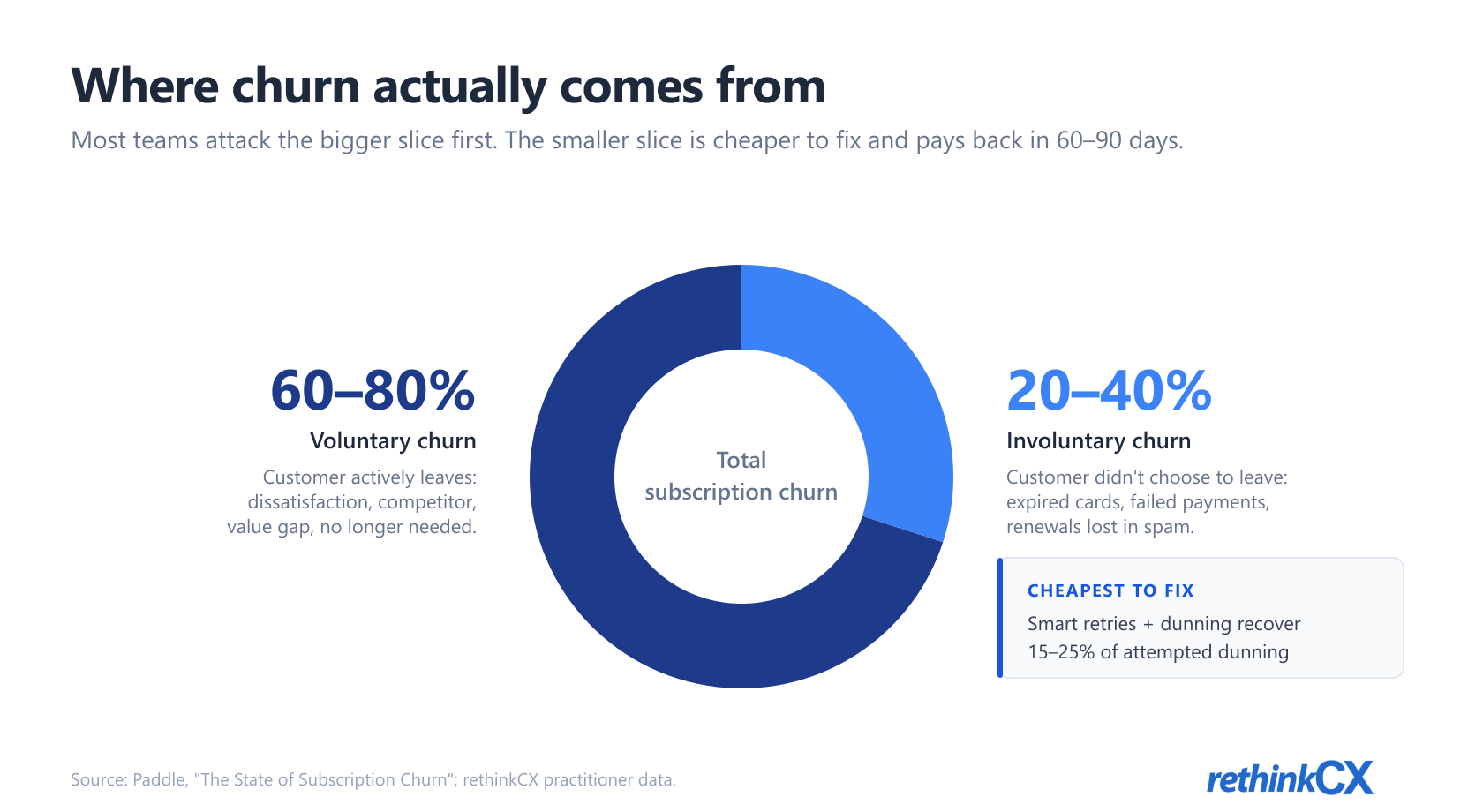
The second distinction is logo churn vs. revenue churn, and this is where most operating teams quietly bleed. More on that in the calculation section below.
Customer Churn by the Numbers
Six figures frame the rest of this guide, each with what it means for the order you fix things in.
- Subscription businesses lose 3.6% of customers a month on average, and about 35% of that is failed payments rather than a decision to leave (Recurly, July 2026). That split is why involuntary churn is the first fix in this guide, not the last.
- B2B annual churn ranges from 11% in energy and utilities to 56% in wholesale, with software at 14% and financial services at 19% (CustomerGauge, 2025). The spread is why a universal "good churn rate" doesn't exist.
- 63% of consumers would switch to a competitor after a single bad experience, up 9% on the year before (Zendesk CX Trends, 2025). One bad contact is rarely the whole reason, but it is often the last one.
- After a bad experience, 13% of consumers stop spending with the company entirely, and fewer than one in three give the company any feedback (Qualtrics XM Institute, 2025). Most churn arrives without a complaint first.
- Acquiring a new customer costs 5 to 25 times more than retaining one, and a 5% rise in retention lifts profit by 25% to 95% (Bain research, reported in Harvard Business Review, 2014). The number is old; it's still the reason retention belongs in the P&L conversation rather than the support budget.
- The median B2B SaaS company has net revenue retention of 82%, against 49% for B2C (ChartMogul, 2025). After upgrades and cancellations, a typical B2B cohort is worth less every year, so expansion has to be built on purpose.
How to Calculate Customer Churn Rate
The standard formula is simple:
Churn Rate = (Customers Lost in Period ÷ Total Customers at Start of Period) × 100
If a SaaS company starts the month with 1,000 customers and loses 50 by the end, the monthly churn rate is (50 ÷ 1,000) × 100 = 5%. Hold that rate constant for a year and you're losing roughly half your customer base annually. The linear math undersells it because of compounding. Because replacing a customer costs several times more than keeping one, churn at this rate quickly outruns acquisition.
Logo churn vs. revenue churn: the metric that fools most teams
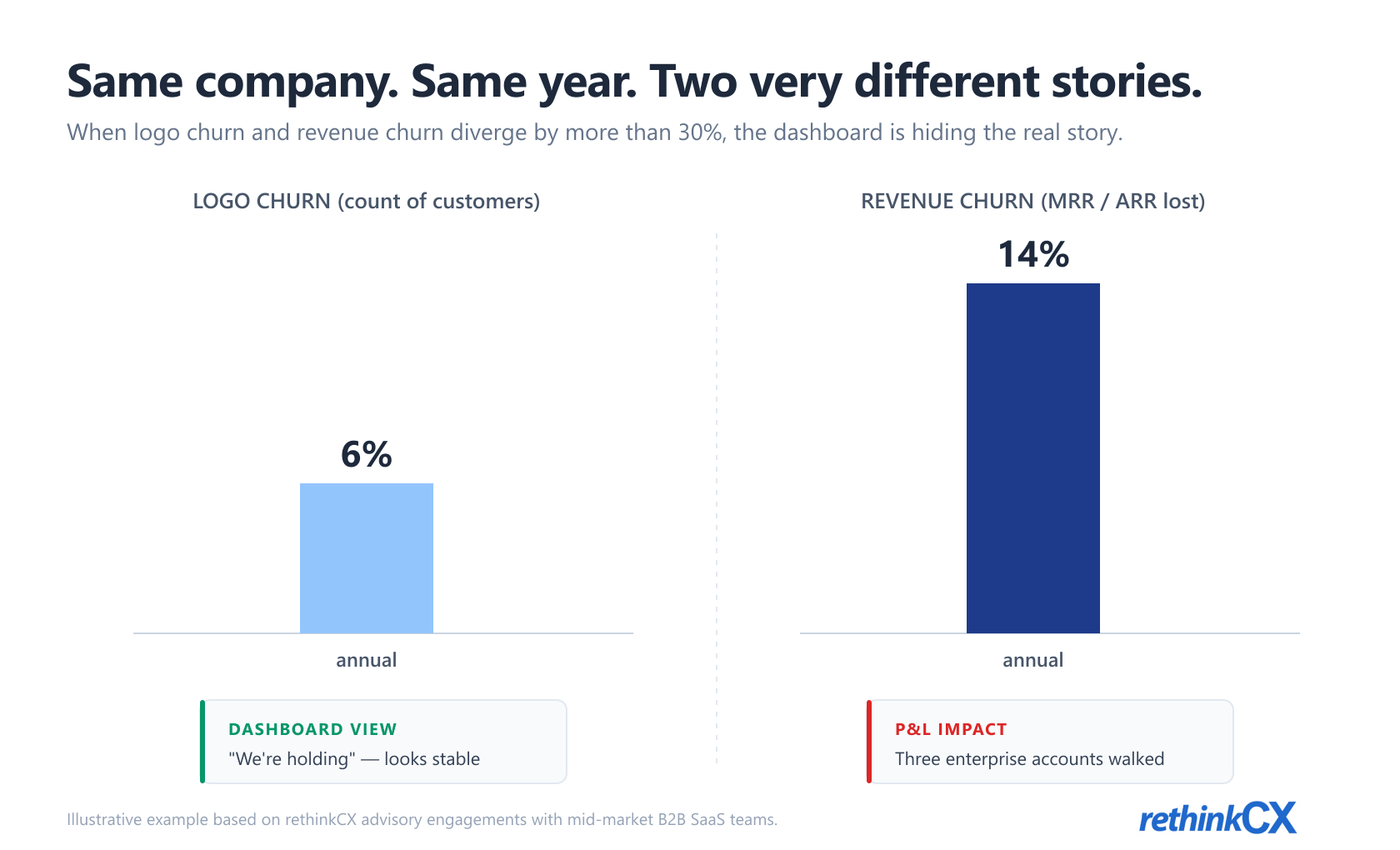
Here's the part most internal dashboards get wrong. Logo churn counts how many customers leave. Revenue churn counts how much money walks out the door. They diverge, almost always, because customers aren't all worth the same. If your largest accounts are leaving at the same rate as your smallest, your revenue churn matches your logo churn. The moment they don't, the two numbers split, and dashboards reporting only logo churn understate the real damage.
I've seen this play out in B2B SaaS environments where logo churn looked stable around 6% annually while revenue churn quietly hit 14% because three enterprise accounts walked. The team pattern-matched on the logo number ("we're holding") and missed that the P&L was bleeding. The fix is unglamorous: report both numbers, every month, side by side. If they diverge by more than 30%, you have an enterprise-retention problem masquerading as a stable-churn story.
Net negative churn: the SaaS holy grail
When expansion revenue from existing customers (upsells, seat additions, plan upgrades) exceeds revenue lost to churn, you get net negative churn. The customer base grows in dollar terms even with no new acquisition. It's the single best signal that a SaaS business has product-market fit at scale, and it's why investors weight expansion ARR so heavily in valuation models. Net negative churn rarely happens by accident; it takes a deliberate expansion motion, and hoping customers spend more over time isn't enough.
Average Customer Churn Rates by Industry
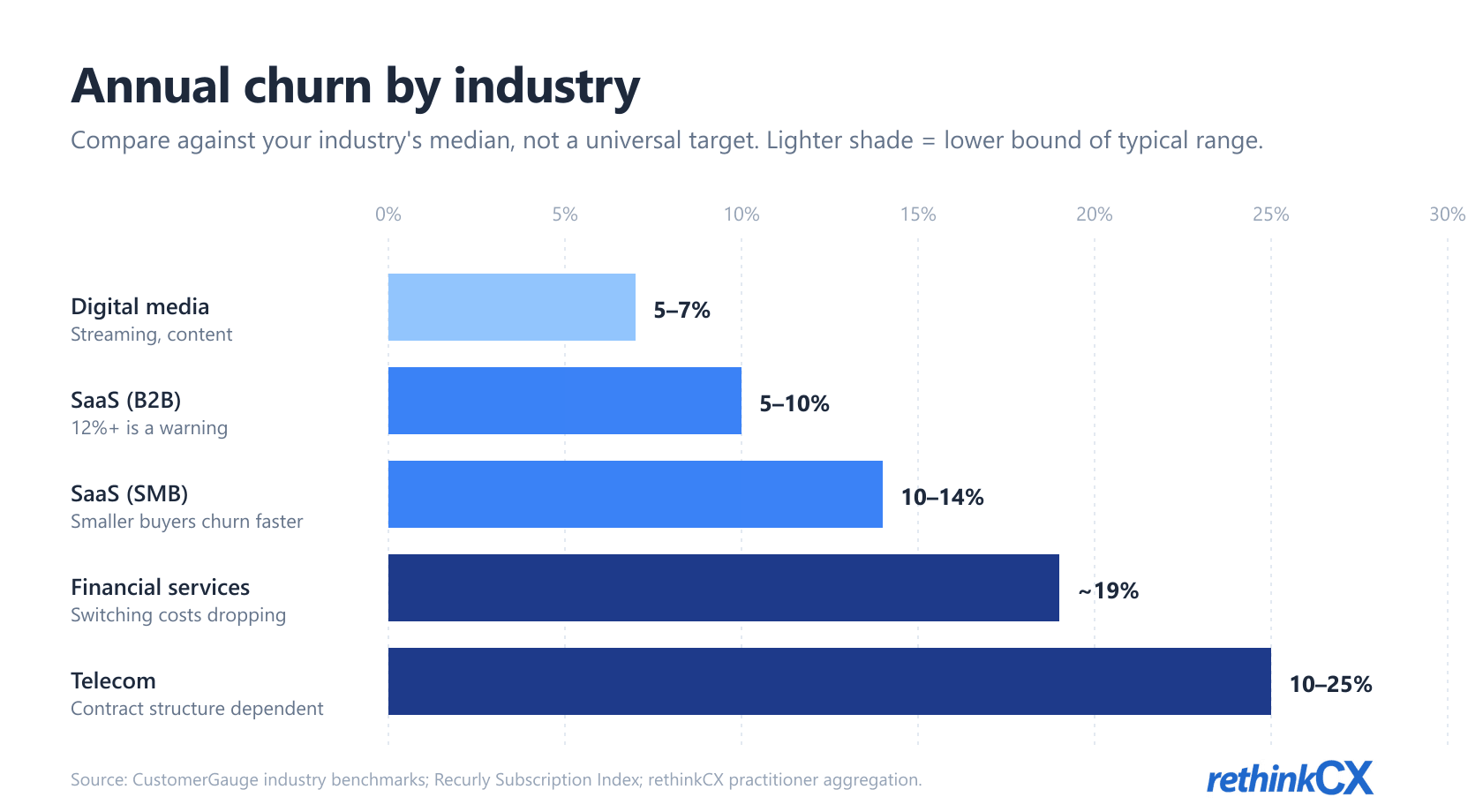
Benchmarks matter because churn is industry-relative, and because the two main data sets measure it differently: subscription businesses track churn monthly, most B2B companies track it annually. Compare yourself against the table that matches how you bill.
For subscription businesses, Recurly's churn benchmarks put average monthly churn at 3.60% across industries in July 2026. That compounds to roughly 36% of customers a year.
| Subscription industry (Recurly, July 2026) | Monthly churn |
|---|---|
| All industries | 3.60% |
| SaaS | 3.22% |
| B2B and professional services | 3.44% |
| Digital media and entertainment | 4.14% |
| Ecommerce | 4.25% |
| Education | 4.99% |
For B2B companies measured annually, CustomerGauge's 2025 benchmarks show annual churn of 14% in software and 19% in financial services, with a range from 11% in energy and utilities to 56% in wholesale.
| B2B industry (CustomerGauge, 2025) | Annual churn |
|---|---|
| Energy and utilities | 11% |
| IT services | 12% |
| Software | 14% |
| Industry services | 17% |
| Financial services | 19% |
| Professional services | 27% |
| Telecom | 31% |
| Manufacturing | 35% |
| Logistics | 40% |
| Consumer packaged goods | 40% |
| Wholesale | 56% |
The benchmark you should compare against is not "good vs. bad." It's your own trend over time and your specific industry's median. A 9% annual SaaS churn rate is fine if you're growing 50% YoY. The same number is a crisis if you're flat.
What actually moves these benchmarks
Three forces dominate. Onboarding quality affects first-90-day churn most. Product-market fit at the cohort level affects 90-day-to-12-month churn. Customer success investment affects post-12-month churn. Most teams over-invest in the third lever (because Customer Success teams are visible) and under-invest in the first two (because onboarding is engineering work and PMF analysis requires honest cohort cuts).
The Real Causes of Customer Churn
The published lists of "top causes" are mostly the same five reasons rearranged. Here's the version that maps to what actually happens inside operating teams:
1. Bad onboarding, the silent first-90-day killer
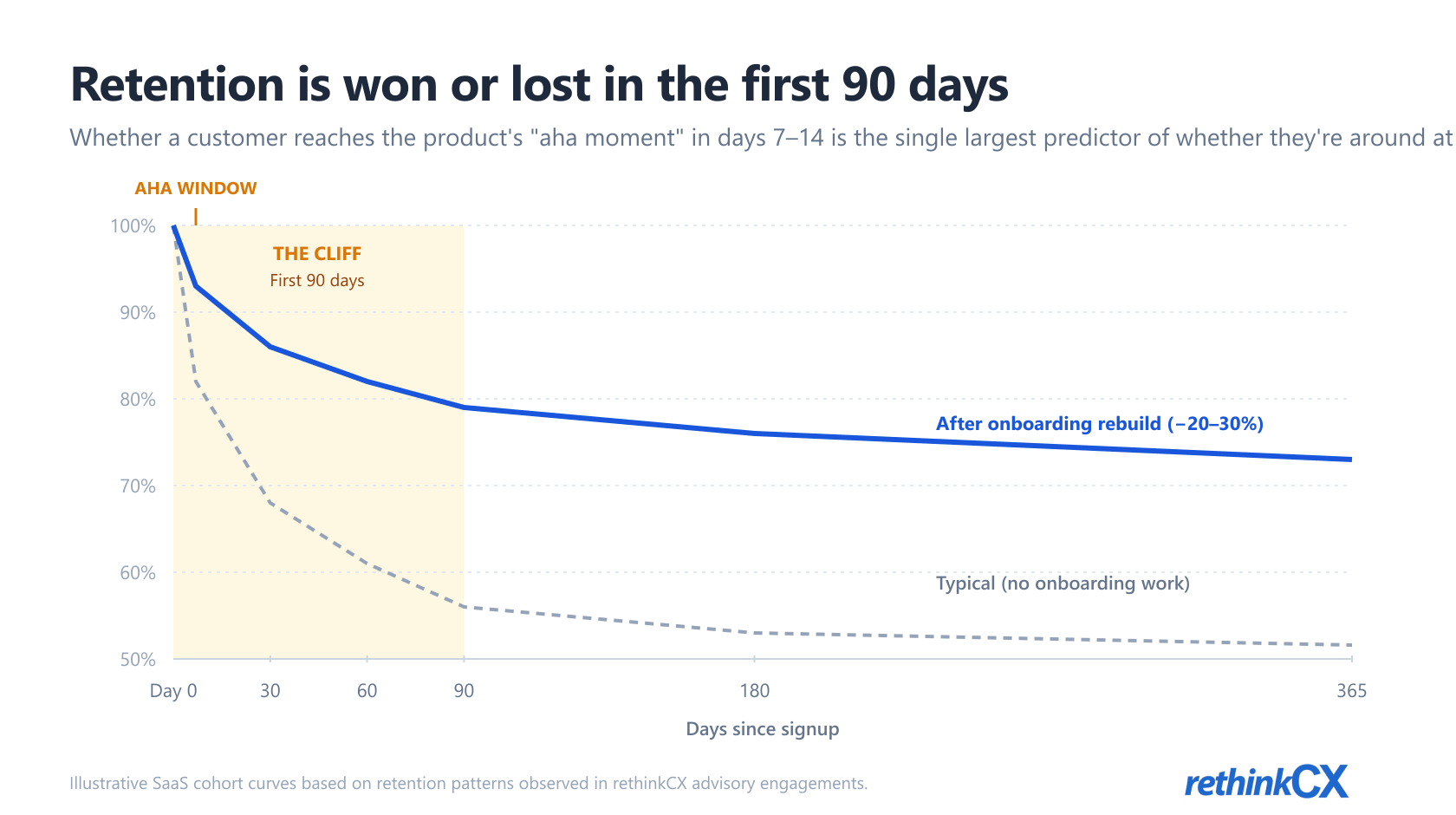
The single largest predictor of whether a customer is still around at month 12 is whether they reached the product's "aha moment" in the first 7 to 14 days. Amplitude's 2025 Product Benchmark Report, covering more than 2,600 companies, found that 69% of the products in the top quartile for seven-day activation were also in the top quartile for three-month retention. In the onboarding rebuilds I've seen, a deliberate flow (interactive walkthroughs, success-milestone tracking, human-touch outreach for high-value accounts) cut first-90-day churn by 20 to 30%. The teams that lose this battle aren't bad at customer service. They shipped a self-service onboarding flow that assumed the customer would figure it out, and most don't.
2. The product not delivering perceived value
Different from "the product is bad." A product can be technically excellent and still churn customers because the value isn't being surfaced. They're not using the features that justify the price, or the ROI loop they bought for hasn't closed yet. This is where building voice of customer programs that actually drive action pays off. The right VoC instrumentation surfaces the value-perception gap before it becomes a cancellation.
3. Poor customer service experiences
Poor service is the most-cited reason for leaving and the least reliable one to act on alone. Zendesk's 2025 CX Trends report found that 63% of consumers would switch to a competitor after a single bad experience. Treat that as a trigger rather than a root cause: "poor service" in a post-cancellation survey is a catch-all customers reach for, and the underlying driver is usually one bad incident on top of an existing readiness to leave. The bigger problem is that you rarely hear about it. In Qualtrics XM Institute's Q3 2025 survey of 20,001 consumers, 13% stopped spending with a company entirely after a bad experience, and fewer than one in three gave the company any feedback. Service quality matters most in the 30 days before a customer was already considering churn. That's the window where one bad call confirms the decision. Which makes coverage in that window a retention variable rather than a cost line, and it is a common reason teams start asking whether in-house staffing is keeping up with the queue.
4. A competitor with a sharper offer
Competitive churn rises in markets where switching costs are dropping. Financial services is the textbook case. Neobanks and embedded finance have made bank-switching frictionless, which is why annual churn in the sector sits near 19%. For most SaaS categories, switching cost is high enough that competitive churn is overstated as a cause; customers rarely switch tools they're successfully using just because a competitor has a better demo.
5. Billing and payment friction (involuntary churn)
The category most teams undercount. Failed credit card transactions, expired cards, declined renewals, dunning emails that go to spam: this is about 35% of subscription churn in Recurly's July 2026 benchmarks, and it's the cheapest category to fix. Recurly's failed-payment recovery data shows how much is recoverable: optimizing retry logic lifted one large retailer from recovering 53% of failed transactions to 71%, and 90% of recovered payments came back within ten days of the failure. That second number is the practical one, because a dunning sequence that starts on day 14 is fighting over the last 10%. If you haven't done this work, do it before any other churn initiative.
6. Price increases
Price is the cause most churn frameworks leave out, and it's the one customers are most explicit about. Deloitte's latest Digital Media Trends survey, fielded with 3,575 US consumers in October and November 2025, found that 61% would cancel their favorite streaming service if its monthly price rose by $5. Streaming is the extreme case, with low switching costs and an alternative one click away, but the mechanic carries over: a price increase forces every customer to decide again whether the product is worth it, and the ones who never reached the value moment answer no. That's why increases hit recent cohorts hardest. Raise prices after onboarding is fixed, not before, and phase the increase for customers still inside their first 90 days.
Why B2B customers leave
B2B customers leave for the same reasons above, but the damage lands differently, because revenue is concentrated and churn is measured annually: 14% a year in software, 19% in financial services and 27% in professional services, per CustomerGauge's 2025 benchmarks. In B2B SaaS the causes that matter most are the value-perception gap and onboarding, since a contract renews on whether the buying organization can point to a result, and a single enterprise account walking can put logo churn at 6% while revenue churn hits 14%. Competitive churn is the cause most overstated in B2B: switching costs are high enough that customers rarely leave a tool they are successfully using. Read the five causes above through that lens rather than as a separate list.
How to Reduce Customer Churn: What Actually Works
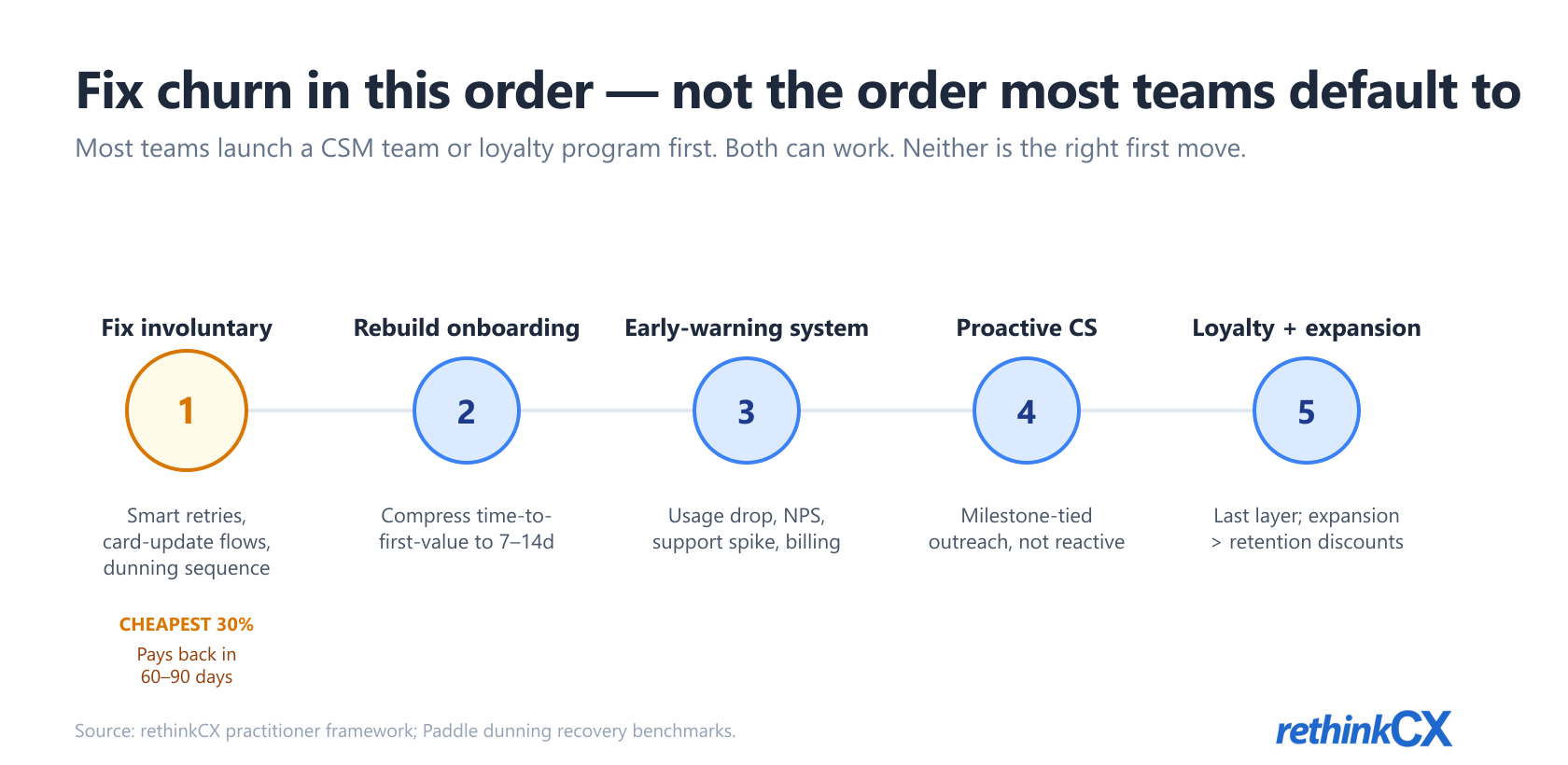
The honest order of operations matters more than the list. Most teams attack churn by launching a customer success initiative or a loyalty program. Both can work, but neither is the right first move, and what most directly causes loyalty in the first place is structurally upstream of either lever. Getting the sequence right — knowing which lever pays back fastest given your specific operation — is the operating-model work our CX strategy advisory is built around. Here's the order that respects ROI and what each lever can actually deliver.
Step 1: Fix involuntary churn first (the cheapest 35%)
Smart payment retries, automated card update via account-updater services, dunning email sequences with clear card-update CTAs, and a "payment failed" recovery flow that's not buried in transactional email. This is engineering work, not strategy work. It typically pays back in 60 to 90 days and is the single highest-ROI churn initiative most teams haven't completed.
Step 2: Rebuild onboarding for first-aha-moment speed
The metric that matters: time-to-first-value. Whatever the product's "aha moment" is (first dashboard built, first export generated, first integration connected), measure how fast customers reach it, then ruthlessly compress that path. This is where most cohort retention curves are won or lost. Generic "welcome series" emails don't move this needle; in-product guidance does.
Step 3: Build an early-warning system for at-risk accounts
This is where data starts mattering. The signals worth watching: usage frequency drop, NPS score decline, support ticket volume spike, key user logout, billing event flagged. The point isn't predicting churn six months out. It's flagging the 60-to-30-day pre-churn window where a CSM intervention still has a chance. The signal stack is the broader 22 customer service KPI framework narrowed to the leading indicators of disengagement. NPS and CSAT are the two scores that forecast churn most directly when read at the right cadence. NPS specifically is one of the strongest leading churn signals; the team at Genuics has a useful breakdown of how to operationalize NPS analysis for early detection that makes the methodology concrete.
Step 4: Proactive customer success motions (not reactive)
Most CSMs run reactive. They respond to inbound tickets and renewal-month panic. Proactive CS means scheduled outreach tied to customer milestones (90-day check-in, mid-contract value review), and the outreach has a specific business agenda: surfacing unused features, identifying expansion opportunities, catching dissatisfaction before it crystallizes. CSM headcount has a real ROI ceiling per account; respect it. For sub-50-employee SaaS companies, dedicated CSMs are usually overinvestment until ARR clears $5M. The infrastructure that connects survey signal to CSM action is the closed-loop case management piece that turns "we have NPS scores" into "we close cases on the detractors." That's what our Voice of Customer consulting builds, and the gap is where most VoC programs stall.
Step 5: Loyalty, retention offers, and expansion plays
These work, but only after the operational fundamentals are in place. Discounts to retain a leaving customer are a measurable last resort; they often work for one renewal cycle and the customer leaves anyway. Expansion plays (upsells, seat additions, plan upgrades) tend to have far better unit economics than retention discounts. For subscription businesses specifically, the engagement mechanics that keep customers paying month after month are their own discipline (onboarding cadence, value moments, anti-cancellation touchpoints), and customer loyalty psychology and program design is the layer above that. Treat both as layered initiatives, not panic buttons.
Predicting Churn with AI and Analytics
The honest summary: AI churn prediction is real, it works, and it's almost always the easy part. In the deployments I've seen, a reasonably built model flags most of the accounts that go on to churn in the next 30 to 90 days, and the major customer-success platforms package it as a turnkey feature.
The hard part is what happens after the prediction. Who calls the flagged customer? With what offer? In what window? Without the post-prediction operating motion, the churn-risk score is decoration on a dashboard. Most failed AI churn programs I've seen failed not because the model was bad (it was fine), but because the company never built the action layer.
This is where AI for customer insights and closed-loop case management workflows start to matter together. The right architecture is: signal (usage drop, NPS detractor, billing event) → flag (model predicts churn risk) → case (assigned to a human with a deadline and a target action) → resolution (logged outcome that feeds the next model iteration). The companies that get this right treat the prediction model as the smallest part of the system.
Tool choice follows from that architecture rather than leading it: which platform fits, and how it sits inside the wider stack, is the work of our CX technologies advisory, and the orchestration it depends on overlaps with the underlying AI personalization patterns.
For the full treatment of model families, the data that actually moves accuracy, and the post-prediction action layer that determines whether the program produces revenue or just dashboards, our dedicated guide on customer churn prediction is the version I wish someone had handed me before the third failed deployment.
What I'd Do Differently
Looking back at the operational decisions I've watched succeed or fail in CX organizations, and at the broader CX strategy framework churn lives inside, the patterns that matter most are the unglamorous ones:
I'd fix involuntary churn before launching any retention program. It's not glamorous, no one writes case studies about it, and it's the single highest-ROI move most subscription teams haven't made. The reason it gets skipped is org-political. It sits in a gap between Engineering, Finance, and CS, and no one owns it cleanly.
I'd report logo churn and revenue churn side by side on every internal dashboard. The day a team starts looking at only one of them, it's the wrong one. If the two numbers diverge by more than 30%, that's the actual story, and it's almost never about the average customer.
I'd resist the urge to staff CSMs before product onboarding is solved. Adding humans to compensate for a broken first-week experience is expensive forever; fixing the first-week experience is expensive once. Most early-stage teams flip this order and pay for it for years.
I'd build the action layer before the prediction model. A simple rule-based at-risk flag with a defined CSM response motion outperforms a sophisticated ML model with no operational follow-through. If the team doesn't know what they'll do with a churn-risk flag at 9am Monday, the model can wait.
I'd track NPS detractors as the leading-edge signal, not a satisfaction trophy. Detractors aren't a brand problem to solve with comms. They're the 60-day pre-churn pipeline. Treat each one as a case to assign, not a number to average, and make sure the tool you track NPS in can actually route a detractor to an owner instead of just charting the score.
I'd benchmark my own CX maturity before scaling any of these plays. The reason most churn programs fail isn't strategy. It's running play-six on a play-two foundation. The 10-minute CX maturity assessment gives you a fast read on whether the operating foundations are ready for the higher-leverage moves in this guide; running them before they are is how the entire program looks busy without moving retention.
The rest of the blog is the rabbit hole.